
Things to Do in Spanish Fork, Utah
Spanish Fork is a small city of about 50,050 at the south end of Utah Valley, and its wedge is one of the most surprising destinations in the state: the Sri Sri Radha Krishna Temple, an ornate Vedic temple that hosts the biggest Holi Festival of Colors and Diwali Festival of Lights celebrations in the western U.S. Holi packs the temple grounds with tens of thousands of visitors on a spring Saturday — a mass color-throw that runs multiple times through the day. Outside the festival weekends the temple is open to visitors for a lunch buffet, llama and peacock viewing, and a self-guided tour. It’s the honest reason to stop in Spanish Fork.
Prefer a guided trip? Compare guided tours and small-group day trips out of the Spanish Fork area — kayak rentals, guided hikes, cave and canyon tours, family experiences:
The Sri Sri Radha Krishna Temple is the destination
The temple was built in 2001 by the Utah Krishnas community on a hillside just east of town — carved wood, marble, a golden altar, gardens with peacocks and llamas roaming the grounds. Outside festival weekends the temple runs a vegetarian Indian buffet on Sundays and is open for self-guided visits most days; check the utahkrishnas.org calendar before you go. The two headline events are Holi (Festival of Colors, late March or early April — dates set by the lunar calendar) and Diwali (Festival of Lights, October or November). Both draw crowds well beyond the temple’s capacity — expect shuttle parking from off-site lots and to walk 10–15 minutes to the gates.
Canyon Glen, Nebo Loop, and the way south
Spanish Fork sits at the mouth of Spanish Fork Canyon (US-6, the main route between Utah Valley and Price / Moab). Canyon Glen Park is the shady picnic-and-splashpad reset a couple of miles up the canyon. Fifteen minutes further south the Nebo Loop Scenic Byway takes off from Payson — the highest continuous paved road in Utah, 37 miles of aspen-and-conifer switchbacks topping out at 9,000+ feet. From Spanish Fork you’re also about 25 minutes from Sundance Mountain Resort via US-89 north and the Alpine Loop, and 45 minutes from Bridal Veil Falls up Provo Canyon.
Fifth Water Hot Springs — the 4.5-mile hike everyone in Utah County knows
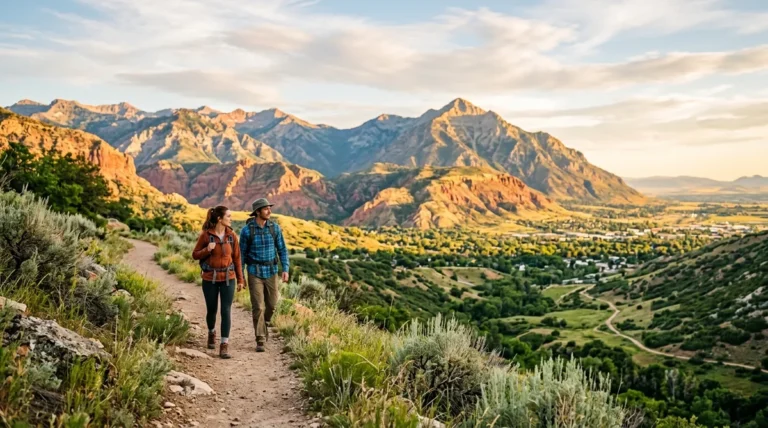
Fifth Water Hot Springs (often called Diamond Fork Hot Springs) is a Forest Service trail that ends at a series of natural warm pools next to a double waterfall — and it’s the single most-hiked backcountry destination in southern Utah County. The trailhead sits about 30 minutes from Spanish Fork: drive US-6 east about 11 miles from town to the signed Diamond Fork Road turnoff, then follow Diamond Fork Road about 10 miles north to the Three Forks Trailhead. The hike is roughly 4.5 miles round-trip with about 700 feet of elevation gain — a moderate, well-graded trail along Sixth Water Creek that ends at three tiers of turquoise-blue pools fed by mineral hot springs at temperatures ranging from lukewarm to genuinely hot (around 100–110°F in the upper pools). Parking is $10 per vehicle, charged by the U.S. Forest Service at the trailhead. The trip logistics that surprise first-timers: the pools are clothing-optional in practice (many mid-week regulars soak nude), weekends and evenings can be genuinely crowded, dogs are allowed on-leash, and there is no potable water on the trail — carry two liters per person minimum. Best time to hike is May through October; the road up Diamond Fork Canyon typically closes in winter (roughly late November through late April, snow-dependent). The trail is doable as a half-day out of Spanish Fork if you leave early, and it pairs naturally with a lunch stop in town on the way home. Verify road status with the Uinta-Wasatch-Cache National Forest before driving in shoulder seasons — winter closures do move year to year.
What most people get wrong
The mistake first-time visitors make is showing up on a Holi Saturday without a plan. Parking fills by mid-morning and shuttle lots run four miles from the temple; if you don’t pre-buy tickets and pick a shuttle window, you’ll spend the day in a parking queue instead of the color throw. The second miss is skipping the temple entirely because it “doesn’t fit” a Utah stereotype — it’s a legitimate architectural stop even outside festival weekends. Third: doing Spanish Fork as a lunch stop rather than a hub. If you’re routing a full Utah County day and want festivals, Sundance, and Nebo Loop in one loop, Spanish Fork is the natural base.
Frequently asked questions
What is Spanish Fork, Utah, known for?
Spanish Fork is best known for the Sri Sri Radha Krishna Temple, which hosts the largest Holi Festival of Colors and Diwali Festival of Lights celebrations in the western United States.
When is the Holi Festival in Spanish Fork?
Late March or early April — the exact date is set by the lunar calendar and varies year to year. Check utahkrishnas.org for the current year’s dates.
Do you need tickets for the Holi Festival?
Yes. Tickets are pre-sold and sell out; day-of walk-ups have been unavailable in recent years. Shuttle-lot parking is required — no on-site parking during the festival.
Is the Krishna Temple open outside festival dates?
Yes. The temple grounds are open most days for self-guided visits, and a vegetarian Indian buffet runs on Sundays. Confirm hours on utahkrishnas.org before visiting.
What else is there to do in Spanish Fork?
Canyon Glen Park a couple of miles up Spanish Fork Canyon, and easy access to Nebo Loop Scenic Byway (via Payson, 15 minutes south) and Sundance Mountain Resort (via US-89, 25 minutes north).
Keep planning your Utah County trip
For the full Utah County itinerary, other city spokes, and the road-trip context, keep reading: Utah County, Utah — Travel Guide · 7-Day Utah National Parks Road Trip · Best Time to Visit Utah.